A behind the scenes look into maintenance practices including past, present and future development plans of the Lac la Biche Golf Club.

Saturday, June 18, 2011

Poa in Full Bloom.

You often here the term poa on golf courses but few actually know what it is or how it can affect daily play. Annual bluegrass (Poa annua L.) is a very common grass species that almost every golf course in North America has. It's very adaptable and can be found on all areas of the golf course including rough, fairways, tees and greens.

In nature,  poa behaves as a true annual. It germinates in spring and/or fall when moisture is adequate and develops quickly, often flowering six to eight weeks after germination. After flowering and setting seed, these annual types die typically from drought and leave dormant viable seed behind to germinate when moisture again becomes available. This efficiency in seed production makes annual bluegrass (poa) a major component of the seed bank of cultivated soils. This seed can remain dormant in the soil profile for up to 6 years.

Many high end golf courses go to great lengths to eliminate Poa. It's a labor intensive, time consuming and expensive practice. So why do it?  Here is a list of the Pros and Cons of Poa annua.

CONS:  -Inconsistent putting speed and roll on the golf green.
               (Greens are slower and do not roll true)
              -Mottled appearance and not aesthetically pleasing to the eye.
                (Poa is light green in color compared to darker green hues of bentgrass)
              -Temper mental growth habit.
                (Does not tolerate too hot, too cold, to wet or too dry conditions)
              -Prone to environmental and cultural stress.
                (Compaction, disease, surface disturbance, traffic, ice and freeze injury,
                  etc.)
             
PROS:   -Usually the first grass to break dormancy from winter.
              -Can provide a true and beautiful putting surface when conditions favor it.
                (ie. Pebble Beach and Oakmont are 100% Poa greens)
              -Naturally reproduce with prolific seed dispersal.
                (Under lush conditions, 14,000-63,000 seeds/ft2/year)
              -Thrives under normal cultural practices.
                (Regular top dressing, verti-cutting and aerating practices)

Poa Seed Heads #6 Greens Collar (June 12, 2011)

My philosophy with regards to poa is one that differs from the high end courses in Alberta. I have a limited budget and work force and accept poa as a fact of life on the course. Over the years I have incorporated bentgrass (A-4) after each core aeration. Currently our greens comprise approximately 60 to 80% poa. It's at this time of year the greens take on a whitish color due to the seed heads. This process will cease in another 3 to 4 weeks and then the greens will take on a darker green most golfers have come to appreciate.  


Poa on #6 Green (June 12, 2011)
 To combat the rougher putting surface the seed heads cause, I lightly topdress the greens on bi-weekly cycles. This helps fill in the voids within the turf canopy and will speed up and smooth out the green. At times this process gets delayed during prolonged periods of wet weather. It's best to topdress the greens during dry conditions so that the sand can be matted in more efficiently. This process is so unobtrusive, golfers don't even know when the greens have been topdressed.


Poa Seed Head (Left) vs. Bentgrass (Right)
(Notice difference in leaf texture and width)

Over the next few years, I plan on over-seeding the greens more often then I do. The addition of our new greens over-seeder the club purchased this month will help immensely in bringing poa populations down to acceptable levels. I am aiming for 40% poa levels but this will take many years to accomplish. We will never be 100% poa free and once a club accepts this, dealing with this overly sensitive grass species will save a lot of time, money and energy. Poa is here to stay so work with it and provide the best possible playing conditions the golf course can financially afford.


Sunday, June 12, 2011

A clASS Act.

#13 Green Divot (June 11, 2011)
It never seizes to amaze me the lack of respect I find on the golf course. It's almost a daily occurance and it will be the subject of a few posts in the near future. In this particular instance, someone decided to take out some frustration right beside the pin. The sad thing is a large tournament had to play with this unnecessary obstacle in their way. In the future for those inclined in perpetrating such stupidity, take your putter in both hands and ram it down hard over your knee. Make sure to listen for that "SNAP!" It will feel so much better and it gives you an excuse to buy another putter since the one you currently broke can't make a short putt. If caught, you will not only be asked to leave but you'll forfeit any future play at our club.

Sunday, June 05, 2011

Irrigation Update.

To say the irrigation system has taken up a lot of my time this past month would be an understatement. We last experienced rain on April 28 (12mm or 1/2"). Couple this with warm winds and it's no wonder the knolls and non-irrigated areas are dry and hard. The course and Lakeland County for that matter are in desperate need of precipitation. It's hard to believe but some courses in the Calgary area have experienced major floods and a few of the mountain courses have seen almost 12" of snow. Edmonton has also seen enough rain and are anticipating drier conditions. Apart from the greens, it's tough even keeping the fairways and rough green and lush. The one positive is 10 to 15 yard increases in driving yardage.

On May 12 my irrigation start up procedure involved priming the mainline. Within 5 minutes I had a break on the side of #7 fairway. Not exactly the start I was looking for. So I fired up the tractor and back hoe and began to dig and repair. The break was an easy one to fix and within 3 hours I was ready to continue priming the mainline. Slowly pressuring the system and rechecking my repair, I have another break about 15 feet back of my original repair. So a few curse words later and extension of the trench, I replaced 20 feet of irrigation pipe. Now I'm good to go and none too soon because the course at this time needs water pretty bad.

Once my mainline is primed, I like to prime each fairway individually. This is done through isolation valves located at the tee and green. At the far end of the fairway or green, I'll use a quick coupler key to vent the water which originates at the tee. This greatly eliminates water hammer which is the number one cause of irrigation breaks particularly at start up. The other benefit to priming the fairways this way is that I'm able to flush the lines of potential debris. It's amazing the sorts of debris that may accumulate in the lines. (Pebbles, gravel, metal flakes from the pumps, weeds and even small fish)

So after a 16 hour day, the irrigation system is finally primed and ready to go. I set up the satellite clocks to water tees and greens that night and hope come morning I have no issues. It rarely turns out that I have no issues unfortunately. One of my biggest problems is heads not completely turning off after their cycle (leaking) and/or heads not turning due to plugged drive nozzles. Our irrigation heads are Rainbird 51DR and 91DR which are impact heads. They are loud and best suited to handle brackish water which makes up the bulk of our irrigation pond. These heads are no longer made by Rainbird and over the years I've been replacing them with 900 series rotary heads. These heads are quieter and so far maintenance free considering our water source.


#7 Mainline Break (May 12, 2011)

#7 Mainline Break on 4" Pipe (May 12, 2011)

Cut Out Section of Mainline (May 12, 2011)

#7 Mainline Repair (May 12, 2011)

In the coming weeks, I hope to preform an irrigation audit to  make sure all heads are working properly. In the past 3 weeks, I have replaced 13 heads, 2 isolation valves and have added 4 new quick couplers at greens. In the near future, I'm planning on hand watering greens more often. This will minimize strain on the irrigation pumps and allow better water metering on the greens. The next spell of rain we get, I'll shut down the system and repair another 5 isolation valves and replace approximately 6 more heads.

Friday, May 06, 2011

18 In Full Swing!!

After a hectic week prepping the course, the B9 is now open. Just a few weeks ago I thought there would be no way the course would be open till mid May. Mother nature had other plans and we're all thankful because of it. The golf course is in fantastic shape and judging by the booking sheet, it'll be a good test this weekend.
To get you up to speed, today all the fairways were cut with the exception of #3 (too wet). The greens were all matted and cut and the first cut of rough got a fresh mow. Next week the pump house will be assembled and the irrigation lines will be primed on Wednesday. If the forecast holds true, we're going to need some water ASAP. Enjoy the weekend and remember to leave the course the way you found it.

Tuesday, May 03, 2011

F9 Officially Opened.

After a long few days of prep, the F9 officially opened today. The rain we experienced last Thursday (April 28) made a huge difference in seeing the course green up. Yesterday we took off all the tarps on the F9. We then cut all the tees, aprons and collars, put out bunker rakes,  erected all tee and advertising signs, double cut all the greens and then cut holes to be used for the following day.
Green #6 (May 2, 2011)
This morning we finished putting out all the ball washers and tee markers and then roped off some of the wet drainage areas on the course. For the time being, carts will be permitted but MUST REMAIN ON THE CART PATHS AT ALL TIMES. Holes #1, 3, 4 & 9 are extremely wet which necessitates cart path only.

The plan for this week is to cut all the tee and green surrounds, the first cut of rough and then continue with tarp removal for the B9 greens. I'm hoping to have all 18 holes in play for Saturday. (Weather Permitting)

In terms of green conditions, we wintered very well with a few greens showing some snow mold damage. Those greens are #3, 5, 13, 18 & the putting green. These greens tend to winter a little worse then the others year after year. In the next few weeks, these greens will be core aerated, over seeded and top dressed to speed up recovery. Plugs will also be done to remove infected areas. The good news is these greens really aren't that bad but when compared to the others which are in fantastic shape, they are lacking aesthetically. Enjoy and respect the golf course and remember to give the maintenance staff the right of way. The staff is instructed to pull to the side when it's safe to do so and they will idle down their machine as you play through. HAPPY GOLFING!!

Wednesday, April 27, 2011

Green Conditions (Spring 2011)

Today, the staff and I had a look under some of the green tarps. We looked under greens #2, 7, 8, 9, 12, 13, 14, 16, 17 the Putting Green and the Nursery which was built last year. Many of these greens have been snow free for the past 2-3 weeks. Yesterday the staff shovelled off the remainder of the snow on greens #3, 11, 15 and 18. These greens remain fairly wet and I plan on having a look under them sometime next week. For tomorrow, the plan is to look under #1, 4, 5, 6, 10 and 18.

What I saw today were greens that wintered well with minimal ice damage. We have some pink snow mold particularly on #13 and the Putting Green. The other greens look great especially #7 and 8 which always seem to be come out "mint" year after year. The greens were cut and the tarps were put back in place. With the exception of #13 and the Putting Green, I plan on taking off the rest of the tarps permanently on Friday or next Monday. (Weather Permitting) This is a time consuming process and needs to be done when the tarp is 100% dry. Tarps that are put away wet are prone to mold and tend to degrade quicker then normal.

It's always an exciting part of the year having a look under the tarps and hoping things will be good. Sometimes I'm pleased and other times not as happy but that's the nature of this business. All the knowledge, money, cultural controls and chemicals in the world mean nothing when "mother nature" decides to reek havoc on a superintendents best lay ed plans.

Green #13: To date, our worst green in terms of pink snow mold.
(Apr. 27, 2011)

Green #12:  Good to Go (Apr. 27, 2011)

Green #7: Year after year, one of our best greens.
Reason being: South Facing, Great Surface Drainage
& Full Morning Sun.
(Apr. 27, 2011)

Green #8: Another great green that winters well.
(Apr. 27, 2011)

First Cut on Nursery. This green was built last year and had been
maintained at tee height. This is the first cut at green height.
(Apr. 27, 2011)

#15 Green: The boys shoveling off the last bit of snow.
(Apr. 26, 2011)

Sunday, April 24, 2011

Paving of Parking Lot.

Hard to imagination what it used to be like prior to the parking lot being paved. I recall a combination of dust and mud and everything in between. The county stepped up to the plate for us on this one and the club and it's visitors are grateful. Here's some pictures of sub-grade prep and the laying down of the asphalt. Perhaps the biggest task of the project was the sub-surface work and making sure all drainage issues were addressed.

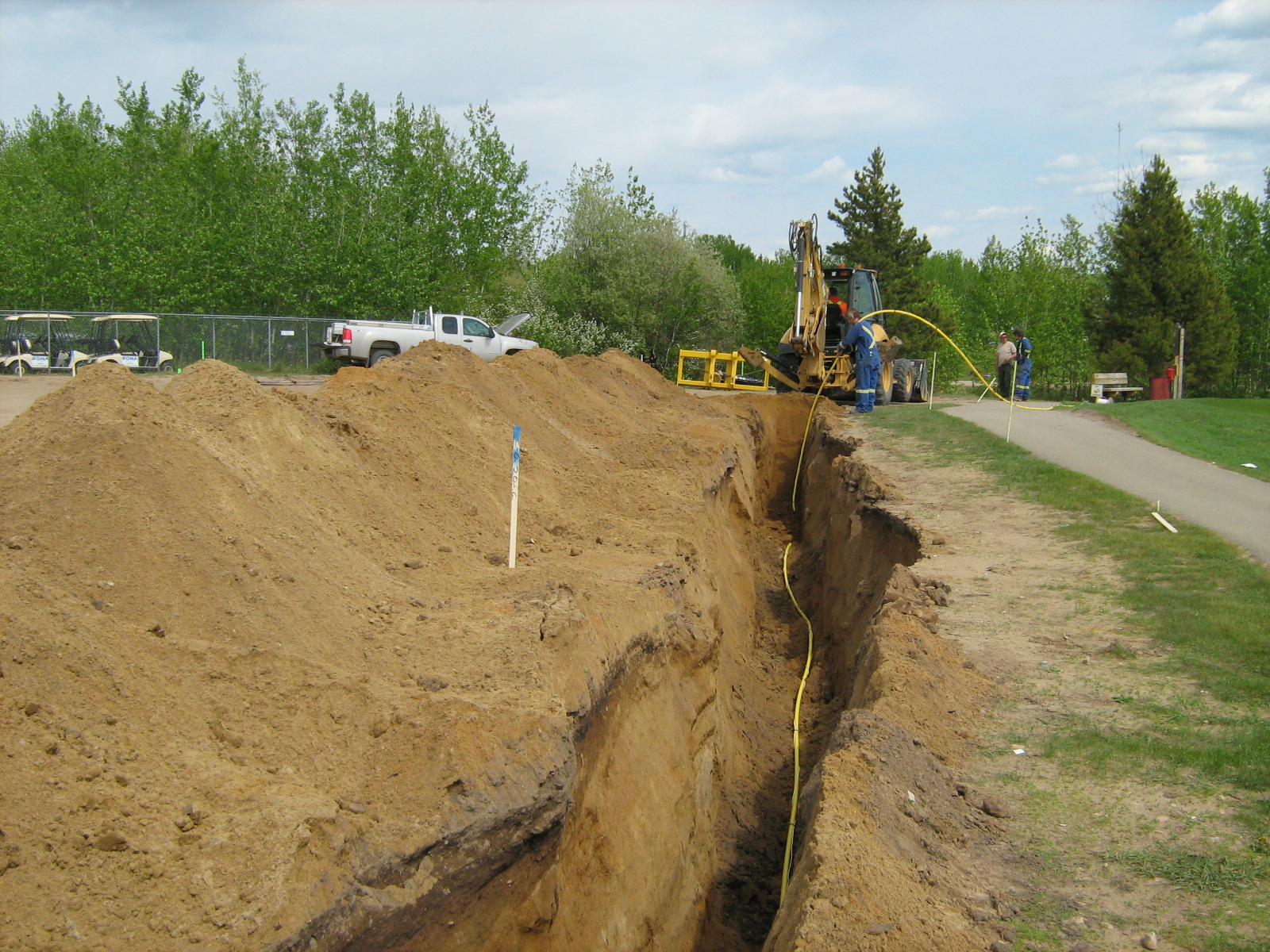
Trenching in New Gas Line for Gazebo. (June 3, 2009)

Hydro-Vac Holes Identifying Gas, Power & Utility Lines.
(June 3, 2009)


Main Drainage Outlet. (June 11, 2009)


Grading & Packing of Gravel Base Prior to Laying of Asphalt.
(June 11, 2009)
 
Laying of Asphalt. Notice the Elevation of the Parking Lot to the Cart
Path on the Right Aiding Drainage Flow. (June 11, 2009)


Finished Parking Lot and Sewer Pump Out. (June 12, 2009)


The parking lot was officially completed a few months later when parking stall lines were painted to maximize user space and direct efficient traffic flow. Concrete barriers were also put in place to keep all traffic contained within the parking lot and curtail potential access onto the golf course.